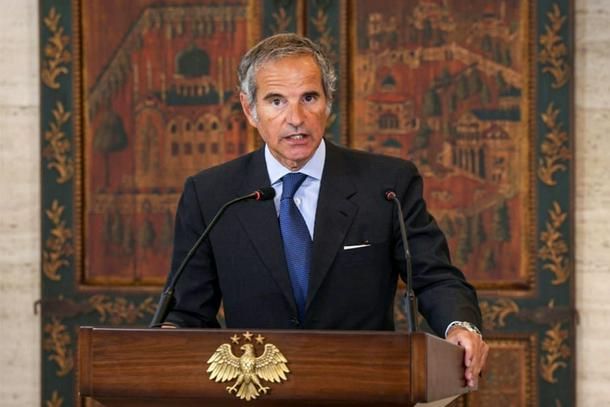
IAEA chief Rafael Grossi visited two sites in Syria
Damascus (AFP) - The head of the UN’s nuclear watchdog said Tuesday its inspectors had found several tons of nuclear material in Syria, at a site Damascus reported to the agency last month.
The inspectors visited two sites, one in Deir Ezzor and “a second location related to the nuclear material identified by Syria recently”, according to a joint statement.
Speaking at a news conference in Damascus, Rafael Grossi, the head of the International Atomic Energy Agency (IAEA), praised Damascus’s “courageous decision” to report the undisclosed site, which dates back to the rule of ousted former leader Bashar-al-Assad.
“We are talking about a few tons of nuclear material that could be put to bad use,” he said, promising that it would be put under international safeguards.
Speaking at a joint press conference with Grossi, Syria’s Foreign Minister Asaad al-Shaibani said: “On July 17, we sent an official letter to the agency, in which we declared of our own free will the presence of nuclear materials at an undeclared site within the legacy left by the former regime.”
Shaibani said technical assessments indicated that the materials do not pose a risk, adding that they “will remain in Syrian national custody and subject to the agency’s safeguards system”.
Grossi meanwhile said “this material will be accounted for, will be put within the international safeguards system”.
Syrian and IAEA experts will work together to safely store the materials, he said.
“We are starting to turn a page, and turning a page does not mean forgetting the past”.
- Likely from reactor -
Grossi also visited a site in Deir Ezzor in the east, which has been shut for 18 years.
In 2018, Israel admitted carrying out a top-secret air raid against the site 11 years earlier.
In 2008, less than a year after the strike, US officials accused Syria of having sought to build a secret nuclear reactor and acknowledged that Israel had destroyed it in the raid.
The UN atomic watchdog declared in 2011 that the Syrian site was “very likely” to have been a nuclear reactor, adding that information provided to it suggested that it was being built with North Korean assistance.
Pierre Razoux, academic director of French think tank the FMES Institute, told AFP the nuclear materials found on Tuesday are “most likely… linked to the Syrian nuclear program, which was halted in 2007 after the Israeli raid on the Al-Kibar site” in Deir Ezzor.
He said, however, that Syria may also have nuclear materials that Iraq rid itself of at the start of the 2000s.
Grossi said the find vindicated the IAEA’s longstanding suspicion that Syria had been secretly building a reactor and that the agency was “at the… site of Deir Ezzor, where a very comprehensive work of excavation and exploration is taking place now”.
The watchdog said last year that it had discovered uranium particles at the site during an inspection in 2024.
Grossi’s visit came after news outlet Axios last week quoted US and Israeli officials as saying Washington and the IAEA reached an agreement to have the watchdog remove nuclear material stored at a clandestine site in Syria after having “reached understandings with Syria and Israel”.
Axios said Israel was closely monitoring a location called “Site 99”, where Israeli officials say the Assad government stored nuclear material that was part of the Deir Ezzor project, also known as Al-Kibar, and that Israel had threatened to bomb it.