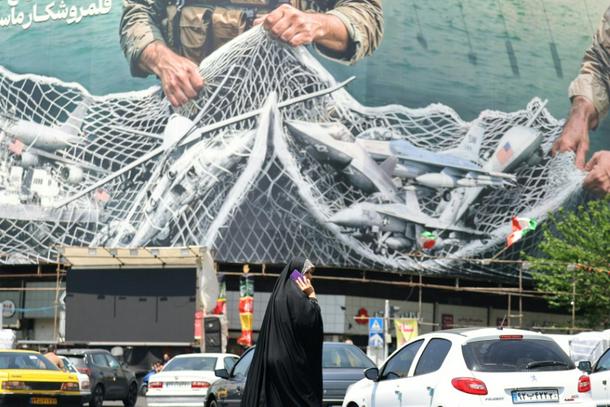
A woman walks past a giant billboard in Tehran that reads 'the Strait of Hormuz remains closed.'
Washington (United States) (AFP) - President Donald Trump said that a US naval blockade against Iran could last months, leading oil prices Wednesday to spike to their highest in more than four years.
With diplomacy between Iran and the United States at a standstill after false starts, Trump spoke by phone with Russian President Vladimir Putin, who warned him of “damaging consequences” if the United States and Israel resume their war on Iran.
Meeting oil executives, Trump contended that the blockade of Iranian ports – which Tehran has demanded must end before any deal – was more effective than bombing.
Trump, at the meeting that took place Tuesday, discussed his efforts “to alleviate global oil markets and steps we could take to continue the current blockade for months if needed and minimize impact on American consumers,” a White House official said on condition of anonymity.
Trump, speaking to Axios, said of the naval action on Iran: “They are choking like a stuffed pig. And it is going to be worse for them.”
Brent oil futures soared another 7.6 percent to $119.69, the highest price since the early days of the Ukraine war in 2022.
Iran has sought to extract a price for being attacked by exerting control over the Strait of Hormuz, the narrow waterway through which one-fifth of global oil typically transits.
- Costs mount -
Trump has faced intense political pressure to end the war, which is unpopular even with much of his base and has increased costs for American consumers paying at the pump.
The Pentagon confirmed to lawmakers on Wednesday that the war has already cost $25 billion to US taxpayers.
Top US officials including Vice President JD Vance twice aborted trips last week to Pakistan to negotiate with Iran, which has voiced doubts about Trump’s sincerity for diplomacy.
Trump again threatened war, posting on social media a mocked-up picture of himself toting a rifle in front of explosions wrecking a desert fortress.
“Iran can’t get their act together…They better get smart soon,” Trump wrote. “No more Mr. Nice Guy!”
US officials contend they do not know who is speaking for Iran, whether it is the hardline and increasingly empowered Revolutionary Guards or diplomats, after Israeli strikes killed a series of top leaders.
The UN Development Programme warned that the war, which has also seen the price of fertilizer soaring, could plunge more than 30 million people into poverty in 160 countries.
“It’s development in reverse,” UNDP chief Alexander De Croo told AFP.
Despite the defiance of the cleric-run state, the Iranian rial fell to historic lows against the dollar.
Tehran residents speaking to AFP journalists in Paris reported a sense of despair.
“Every time in recent years that negotiations have taken place, the economic situation of the people has only gotten worse. Sanctions have either started or intensified,” a 52-year-old architect told AFP, speaking on condition of anonymity.
“They go to negotiate and come back with even more sanctions, and the issue is always nuclear. There’s no talk about people, the economy or freedom. People have the right to not even want to hear the word ‘negotiation’,” he said.
- ‘No trust’ -
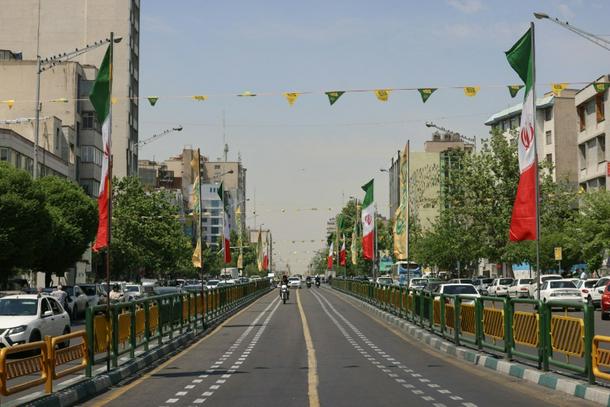
Vehicles drive along a street adorned with Iranian flags at Revolution Square in Tehran
An Iranian army spokesman said Tuesday that “we do not consider the war to be over,” saying Tehran had “no trust in America.”
“We have many cards that we have not yet used,” Amir Akraminia told state television.
Iran has proposed easing its chokehold over the Strait of Hormuz as Washington lifts its blockade and broader negotiations take place. The Trump administration has viewed the proposal skeptically.
Iran’s speaker of parliament Mohammad Bagher Ghalibaf, who has emerged as a key figure since the start of the war, said on Wednesday the US naval blockade of the country aimed to create division and “make us collapse from within.”
He said Trump “divides the country into two groups: hardliners and moderates, and then immediately talks about a naval blockade to force Iran into submission through economic pressure and internal discord,” state TV reported. He called for unity in response.
- ‘Attacks cannot continue’ -
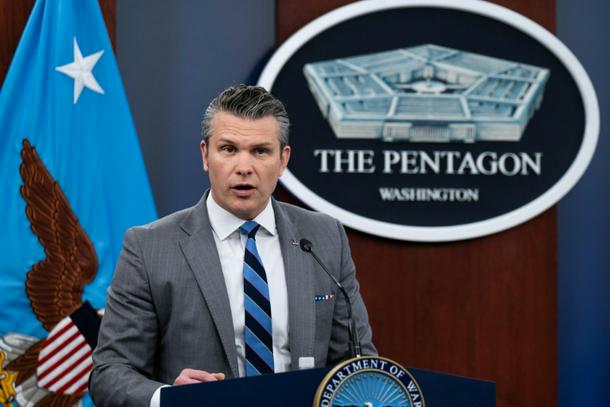
Pentagon chief Pete Hegseth is testified before Congress on the war
Violence has continued on the war’s Lebanese front, despite a recently extended ceasefire between Israel and Hezbollah, the Iran-backed armed group that drew Lebanon into the war by firing rockets at Israel. Israel responded with strikes and a ground invasion.
For the first time since the ceasefire began, the Lebanese army said on Tuesday that an Israeli strike had targeted its troops, wounding two soldiers in the south. Another strike on Wednesday killed a Lebanese soldier, it said.
“Israel must finally realise that the only path to security is through negotiations, but it must first fully implement the ceasefire in order to move on to negotiations,” Lebanese President Joseph Aoun said in a statement.
“Israeli attacks cannot continue as they are,” he said. “We are now waiting for the United States to set a date to begin direct negotiations.”
A UN-backed report said on Wednesday that more than 1.2 million people in Lebanon were expected to face acute hunger due to the latest war.
burs-dc-sct/msp