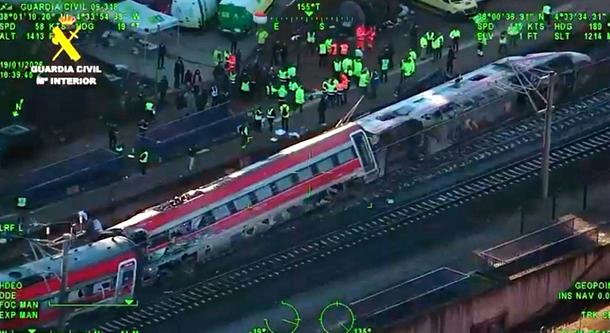
Sunday's crash was the deadliest train accident in Spain since 2013
Adamuz (Spain) (AFP) - Spain began three days of national mourning on Tuesday for 41 people killed after two high-speed trains collided in the country’s deadliest train accident in over a decade.
The disaster took place late Sunday when a train operated by rail company Iryo, travelling from Malaga to Madrid, derailed near Adamuz in the southern Andalusia region.
It crossed on to the other track, where it crashed into an oncoming train, which also derailed.
The death toll rose to 41 after the body of a passenger was recovered on Monday evening from one of the Iryo train carriages, the regional government said.
Over 120 people were injured, with 39 still in hospital, including four children, it added.
Flags flew at half-mast on public buildings, television anchors wore black, and cabinet ministers curtailed public appearances as Spain observed the first of three days of national mourning.
Heavy machinery was deployed on Monday to lift the most severely damaged train carriages and give rescuers better access.
The head of Andalusia’s regional government, Juan Manuel Moreno, warned Monday it would take another 24-48 hours “to know with certainty how many deaths have resulted from this terrible accident”.
King Felipe VI and Queen Letizia were scheduled to meet with rescuers and officials in Adamuz later on Tuesday.
- ‘Harrowing’ -
Aerial footage of the crash site from Spain’s Guardia Civil police showed the two trains far apart, as rescuers in high-visibility neon vests worked nearby.
Among the survivors is a six-year-old girl who lost her parents, brother and cousin in the crash, according to Spanish media.
The 27-year-old driver of one of the trains was among those killed, daily newspaper El Pais reported.
The collision occurred in a hilly, olive-growing region accessible only by a single-track road, making it difficult for ambulances to reach the area.
Firefighter Angel Uceda, who was among the first rescuers on the scene, told Onda Cero radio that mobile phones were ringing beside injured victims as he entered the wrecked train carriages.
“It was harrowing, but we had to do our job and do what was needed,” he said.
Unlike the 2013 accident, the derailment occurred on a straight section of track, and the trains were travelling within the speed limit, officials said.
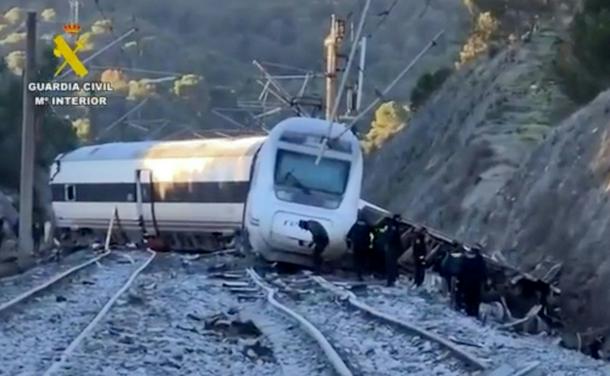
One of the trains was carrying around 300 people, and the other had 184 passengers
Transport Minister Oscar Puente said the first train to derail was “practically new” and the section of the track where the disaster happened had been recently renovated, making the accident “extremely strange”.
The company said around 300 people were on board its service from the Andalusian city of Malaga to the capital, Madrid.
Renfe, the operator of the second train travelling to the southern city of Huelva, said it was carrying 184 passengers.
- Solidarity -
Human error has “been practically ruled out”, Renfe President Alvaro Fernandez Heredia told Spanish public radio RNE.
Heredia also ruled out speeding as a cause of the accident. He said both trains were traveling just over 200 kilometres (120 miles) per hour, below the 250 kilometres per hour limit for that section of track.
Spain has Europe’s largest high-speed rail network, with more than 3,000 kilometres of dedicated tracks connecting major cities including Madrid, Barcelona, Seville, Valencia and Malaga.
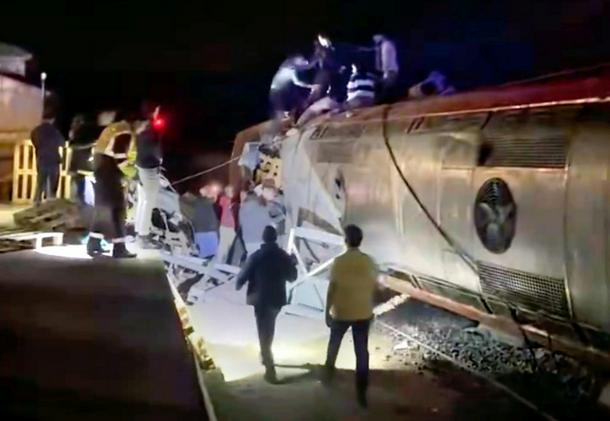
Spain has declared three days of national mourning
In Adamuz, where white buildings gleam among orange-lined streets, residents rushed to the town hall with supplies as news of the disaster spread.
“We started bringing water, blankets, everything we could,” Manuel Munoz, a 60-year-old olive oil factory worker, told AFP.
Among those offering condolences were Pope Leo XIV and French President Emmanuel Macron.