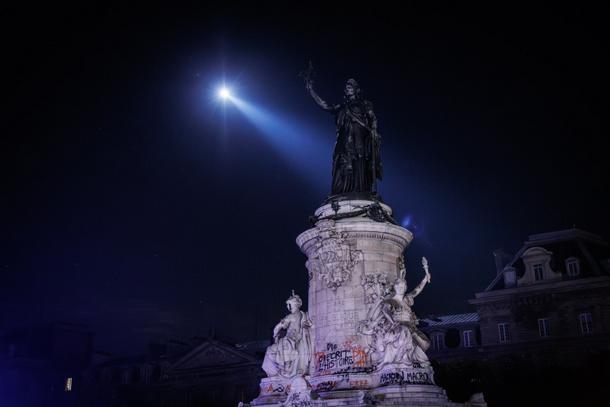
A helicopter patrols over the Place de la Republique in Paris in the early hours of Tuesday, during a curfew in place there and other zones in the capital
Paris (France) (AFP) - France’s prime minister was to meet union leaders on Wednesday as the country prepares for new protests following those last weekend that descended into the worst riots seen in years.
Prime Minister Sebastien Lecornu has vowed a “massive” police deployment for the fresh demonstrations called for Saturday by the Yellow Vest movement.
His government has admitted its law enforcement officers “lost control” of the violence unleashed last weekend, when nationwide marches against high inflation devolved into clashes, vandalism of public buildings and looting.
Since then, authorities have ordered partial curfews in parts of Paris and other cities to prevent further scenes of violence.
The curfews meant many commuters could not take their regular urban rail services back home, but some late Tuesday said they understood.
“It’s quite disconcerting,” said one who gave only his first name, Louis, when he found his line closed. But “if it can prevent further acts of vandalism… then yes, I think it’s a good thing”, he said.
- Markets rattled -
France’s unrest – coming on top of weeks of student protests – has unsettled financial markets, with the Paris stock market and government bonds falling on Monday.
On Friday, the Moody’s ratings agency is expected to lower its grade on France’s public debt, which is one of the highest in the EU compared with GDP.
France’s neighbours Italy and Belgium have started to experience similar unrest, on a smaller scale. Italy’s government has ordered 500 troops to Milan to stem street violence there.
France’s woes are compounded by the fact that President Emmanuel Macron is in his final months of office.
Far-left and far-right politicians vying to succeed him in April-May elections have little interest in cooperating with his government.
France’s political landscape is so fragmented that Lecornu has little chance of winning parliamentary consensus, not even for a cost-cutting budget that needs to be adopted before the end of this year.
Lecornu will meet with representatives from five unions on Wednesday to discuss “ways and means to guarantee the essential freedom to demonstrate” according to a letter sent to the organisations. It alleged that some were attempting to subvert the protests with “unacceptable acts”.
The head of the CGT union that has been prominent in the demonstrations, Sophie Binet, warned on RTL radio that Lecornu “needs to respond to the demands” of the unions and young protesters.
She said there was “legitimate and enormous anger” in France.
Her union is demanding the government increase the minimum wage, boost salaries in line with inflation, and ensure enough money for schools and public services.
- Bastille march called -
The Yellow Vest movement behind last weekend’s demonstrations announced Wednesday it has formally told authorities it planned to hold its Paris march on Saturday starting from Bastille square.
The movement also wants to hold follow-up nationwide demonstrations on November 5.
The images broadcast around the world of France’s street violence last weekend have prompted several countries, including the United States, China and Germany, to issue travel advisories for their citizens in France.
French authorities have faced criticism from parties across the political spectrum, with far-right presidential candidate Marine Le Pen describing the unrest as a “wake-up call” that exposed a “profound crisis” of authority.
The latest survey, carried out by Ifop in the wake of the riots, suggested Le Pen would lead first-round voting intentions by a wide margin and far-left candidate Jean-Luc Melenchon emerged as her most likely opponent in the runoff.
In a sign of growing political scrutiny over the street violence, lawmakers from across France’s fractured parliament agreed on Tuesday to launch a parliamentary inquiry into the unrest, including possible intelligence failures, policing tactics and the government’s preparedness.
Nearly 150 people had been jailed and more than 800 brought before the courts, according to the justice minister.