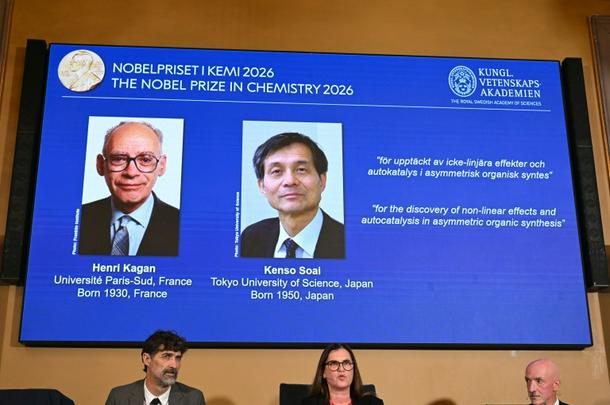
Henri Kagan and Kenso Soai solved a century-old chemical mystery
Stockholm (AFP) - France’s Henri Kagan and Japan’s Kenso Soai on Wednesday won the Nobel Prize in Chemistry for discovering how to manipulate forms of key molecules, a crucial breakthrough for drug manufacturing.
Like hands, molecules such as amino acids exist as two mirrored variants, but only one of them is found in the proteins in the body’s cells – a phenomenon known as “homochirality”.
“Henri Kagan and Kenso Soai have provided a solution to a chemical mystery that is over a century old: how homochirality can emerge spontaneously,” Heiner Linke, chair of the Nobel Committee for Chemistry, told a press conference.
Kagan, 95, is professor emeritus at the Universite Paris-Saclay in France while Soai, 76, is a professor at Tokyo University of Science.
Soai said he had received the call while out shopping for groceries.
He said he was “extremely happy” to be honoured together with Kagan.
French President Emmanuel Macron congratulated Kagan on his prize on X, calling his achievement “a tremendous source of pride for the country”.
- ‘Truly wonderful people’ -
The academy in a separate statement likened the chirality conundrum to a locksmith creating keys to order but whenever they produce them they get two mirrored variants.
“Only one of them fits the lock – and the lock can be damaged if your customers try to unlock it with the other key.”
One example of the potential danger of using the wrong key, or version, was the thalidomide scandal in the late 1950s and early 1960s, when thousands of children were born with birth defects.
“When researchers analysed what had happened, they realised that it was the active substance’s mirror image that caused the harm,” the academy said.
Phillip Broadwith, an editor at the Royal Society of Chemistry’s Chemistry World magazine, said the duo’s work “goes to the very fundamental level of understanding how we can control which ‘hand’ of a molecule we make”.
Controlling “is crucial for making things like drugs or even flavours and fragrances”, Broadwith said.
“It also helps to explain a possible way that all the chiral molecules on earth -– our proteins, sugars and biomolecules, settled into one specific handedness rather than the other,” he said in an email sent to AFP by the society.
- Manipulating reactions -
In the 1980s, Kagan found a new way of manipulating chemical reactions to create an excess of one of the mirror-image forms.
Soai later took the next step and in 1995 published a key paper describing a chemical reaction that could create the chosen version of a molecule, the jury said.
In 2003, he succeeded.
“The Soai reaction is considered one of the most elegant chemical experiments ever conducted,” the academy said.
Speaking to reporters in Tokyo, Soai said he was grateful for having had good science partners, both fellow researchers and students.
“Especially in experimental science, the combination between faculty and students is crucial. In that sense, I’ve been fortunate to meet truly wonderful people,” he said.
“Looking back on my life from that perspective, I can say that there has been a deep, genuine sense of fulfillment and inspiration.”
- Earlier controversy -
Kagan had previously missed out on the Nobel prize.
In 2001, the chemistry prize was awarded to William Knowles, Ryoji Noyori and Barry Sharpless for their pioneering work in “asymmetric catalysis”.
Many French chemists were outraged by the absence of the man regarded internationally as the “father” of the technique.
The chemistry prize follows the physics prize, which on Tuesday honoured Belgian physicist Francis Halzen for using Antarctic ice to capture particles originating in the distant cosmos.
On Monday, the medicine prize was awarded to US psychiatrist and neurologist Karl Deisseroth and German scientists Peter Hegemann and Georg Nagel.
The literature laureate will be revealed on Thursday, and perhaps the most keenly anticipated award – the peace prize – is due on Friday.
The economics prize wraps up the Nobel season on October 12.