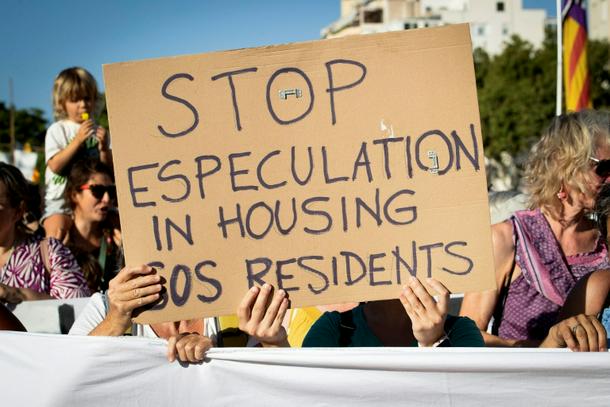
Short-term lodgings are blamed by residents in many popular travel destinations for pushing up prices
Brussels (Belgium) (AFP) - European cities will gain more leeway to curb short-term rentals such as Airbnb under new EU plans that aim to bring down housing costs in tourism hotspots.
The European Commission laid out conditions Wednesday under which local authorities can limit short lets, under a proposal seeking to address Europe’s “housing crisis”.
“Short-term rentals are a part of the problem in many cities,” Dan Jorgensen, the 27-nation bloc’s housing commissioner, told a press conference in Brussels.
Though hugely popular with visitors, short-term lodgings are blamed by residents in many popular travel destinations for depriving locals of apartments for long-term rent and pushing up prices – something holiday let providers dispute.
Cities from New York to Tokyo and Barcelona have imposed or considered restrictions on tourist flats in recent years. But curbs have often been met with court challenges, resulting in legal uncertainty.
The commission’s Affordable Housing Act – which still has to be negotiated with lawmakers and EU countries – aims to provide cities with legal cover, clarifying when authorities can take action without falling foul of the bloc’s single market rules.
“They shouldn’t fear that they can be dragged into court,” Jorgensen said.
- ‘Housing stress’ -
Tech lobby group CCIA, whose members include Airbnb, said the rules marked a “clear improvement over the restrict-first-ask-later approach taken by cities to date”. But it complained about the lack of enforcement mechanisms.
“With little provision for independent scrutiny or effective redress, disproportionate restrictions could still be imposed unchallenged and remain in place for years,” it said.
Cities and other relevant authorities would be allowed under the plans to limit holiday rentals as well as the purchase of property for short-term letting purposes in areas deemed “under housing stress”.
The definition applies to districts where the price of an average size home is at least eight times that of locals’ disposable per-capita income.
Before introducing restrictions, authorities must show short-term rentals have had a significant adverse effect on housing affordability or availability for at least three years.
Measures must be non-discriminatory, proportionate and limited to five years.
The legislation will not affect landlords who rent out their own primary residence for short periods, nor rules cities had previously brought in.
- ‘Crowded out’ -
More than half of EU city dwellers told a 2025 survey housing affordability was “an immediate and urgent problem”.
Property prices in the bloc have surged by 60 percent in a decade, while rents have climbed 20 percent, Brussels says.
The EU says this is mainly driven by insufficient housing supply, but short-term rentals – which grew 93 percent across four major platforms between 2018 and 2024 – added pressure.
Short rentals account for only about 1.2 percent of the European Union’s total housing stock but can reach 20 percent in popular tourist districts, EU data shows.
Residents have been “crowded out of their homes” leading to “totally unacceptable” price increases, Jorgensen said.
“Over the past 10 years, rents have gone up by 59 percent in Berlin, by 75 percent in Madrid, by 103 percent in Lisbon. This means that normal people with normal jobs – nurses, schoolteachers, police officers – are not able, very often, to live where they serve,” he said.
Yet rental providers deny holiday lets are to blame.
In a letter to the commission, the CCIA said that in some cities with restrictions, both local rents and hotel prices have risen regardless, noting that Lisbon recently overturned some of the curbs it had previously imposed.
Airbnb warned the EU’s plan as drafted would “not add homes, while creating increased regulatory uncertainty for hosts across European cities.”
Short-term rentals generated some 40 billion euros in tax revenue and more than two million jobs EU-wide in 2023, it said.
George Mavros, Airbnb’s head of EU government affairs, said that making housing more affordable required a focus on “construction, renovation, and the homes standing empty across Europe today”.