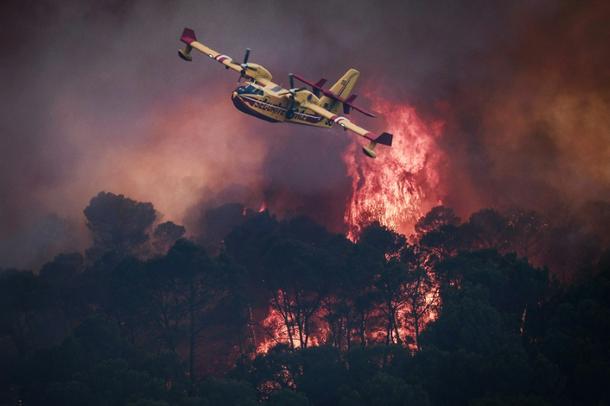
Aircraft are fighting blazes in France and Italy
Lège-Cap-Ferret (France) (AFP) - Wildfires fanned by scorching temperatures and strong winds swept through parts of western Europe on Friday, triggering a state of emergency in the Spanish capital region and prompting France to seek aid from the European Union.
French authorities have ordered thousands of tourists on the southwestern Atlantic coast out of campsites and holiday homes, as firefighters backed by water-bombing planes raced to control the blazes.
The total area of land burnt so far this year in EU countries is the second largest on record, according to satellite data from the European Forest Fire Information System (EFFIS).
Three firefighters have been killed as southern Europe endures more severe heat, with temperatures topping 40C in some areas.
France has invoked the European Union’s civil protection mechanism to ask for help, President Emmanuel Macron said on Friday, warning that the crisis remained “very intense”.
EU crisis management commissioner Hadja Lahbib said Thursday that the bloc was providing three water-bombing planes to France.
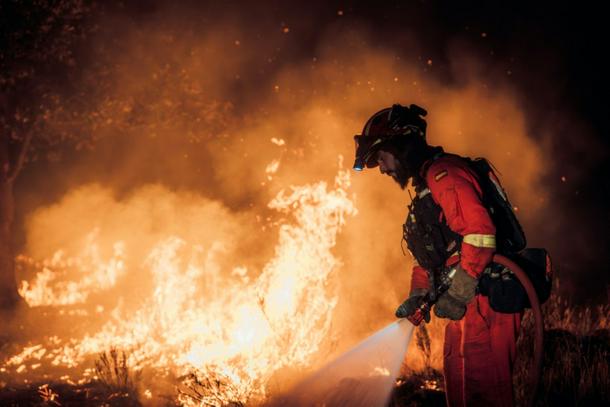
A fire broke out Wednesday near the city of Toledo south of Madrid
Patrick Martineau, a 69-year-old resident of Le Porge, south of Bordeaux, said, “The gendarmes came and knocked on every door, the fire was about 500 metres away – we grabbed some things and left.”
France’s southeast was also being hard hit, with dozens of fires flaring up and being fanned by the mistral wind around the historic village of Cotignac – officials saying around 25 houses had been destroyed since Tuesday.
Thousands of emergency workers in Italy battled scores of fires in Sicily and in the Calabria region, where a local official said arsonists had started fires by tying rags soaked in flammable liquid to the tails of stray cats to spread the flames.
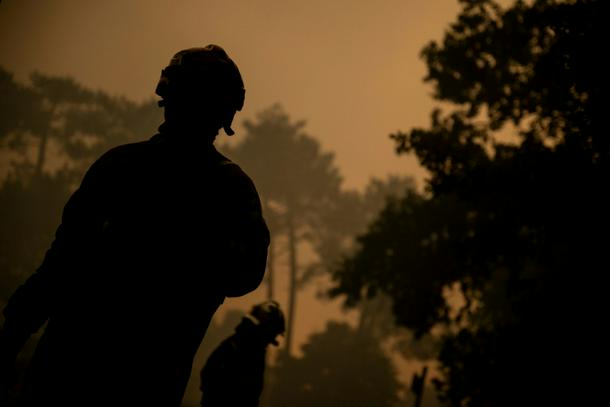
Firefighters were now battling 'house by house' to protect the tourist hub of Lege-Cap-Ferret
One firefighter died after falling ill while battling the flames in Sicily, the interior minister said.
Around Bordeaux, more than 20,000 people – mostly tourists in campsites and holiday lets – have been evacuated since Wednesday, as a fire ravaged a seaside pine forest.
The authorities said the fire had been contained on its northerly flank but was not yet totally under control further south.
Firefighters were now battling “house by house” to protect the tourist hub of Lege-Cap-Ferret, said regional wildfire chief Marc Vermeulen.
Two firefighters died on Tuesday tackling another blaze near Bordeaux airport.
- ‘No chance’ -
Skies over Le Porge turned orange as smoke rose from charred and crackling pine trees, while helicopters made repeated runs over deserted neighbourhoods.
Fires in 2022 damaged a massive area of the same forest, forcing around 50,000 people to flee.
The blazes are breaking out faster because of climate change caused by the burning of oil, coal and gas. European droughts are now more severe, climatologists from the World Weather Attribution group said in a study published on Thursday.
In Spain, the government declared a state of emergency in the Madrid region, where more than 10,000 people have been evacuated in recent days.
Emergency services said alert messages had been sent to people in Aldea de Fresno, a town west of Madrid, ordering them to leave.
Eighteen firefighting units with specialist troops were working to contain the blaze, close to another wildfire on Wednesday near the city of Toledo that forced the evacuation of several villages.
Firefighters battled through the night and most residents were allowed to return Thursday.
Hundreds of firefighters and troops were still struggling to contain a much larger wildfire in Guadalajara province, north of Madrid.
“Climate change is what kills, what destroys our villages and our natural and cultural heritage,” civil protection chief Virginia Barcones told Spanish radio.
She warned some fires become so intense that, despite the deployment of aircraft and ground crews, firefighters stand “no chance”.
Barcones said conditions at the Guadalajara blaze were improving but that strong winds and extreme heat remained a danger.
burs-jxb/ach/cms/hol