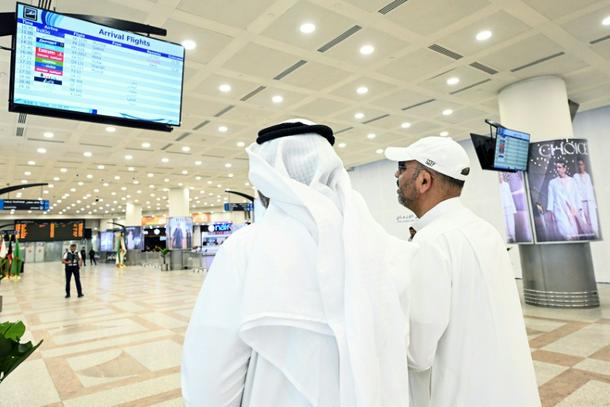
Kuwait International Airport reopened on June 1 only to be closed again Wednesday after what local officials decribed as an Iranian drone strike
Kuwait City (Kuwait) (AFP) - An Iranian drone strike on a passenger terminal at Kuwait’s international airport killed an Indian citizen and wounded 63 people on Wednesday, as conflict flared between Tehran and US forces in the Gulf.
Kuwait’s military condemned the strike as an act of “criminal Iranian aggression”, while Iran’s Revolutionary Guards accused US forces of provoking a response by targeting a tanker and a communications tower on the country’s Qeshm Island.
The attacks constitute one of the more severe tests yet of a fragile April 8 ceasefire that paused more than a month of war sparked by the US-Israeli bombing of Iran, and has largely held despite sporadic exchanges of fire.
India’s foreign ministry confirmed that one of its nationals was killed and several others were wounded in the airport strike.
Israeli Prime Minister Benjamin Netanyahu accused Iran of “playing with fire”.
“Iran surely knows what the (US) president has said, that if necessary, there’ll be a full-scale return to military action,” Netanyahu warned in an interview with US channel CNBC, referring to threats made by Donald Trump.
Kuwaiti health ministry spokesman Abdullah al-Sanad said 63 people were treated for injuries “including head wounds, cerebral hemorrhages, amputations and injuries resulting from explosions”.
Kuwait suspended air traffic and diverted arriving planes to other destinations, but later restarted Kuwait Airways flights.
The international airport has been targeted several times during the war, and had only fully resumed operations on Monday.
The Gulf nation said it detected a total of 30 ballistic missiles and drones launched Wednesday during the “heinous Iranian aggression”.
It denied Iranian claims that Kuwaiti territory and airspace had been used to attack the country.
- ‘Not normal’ -
Hassan Sheikh, a 40-year-old Pakistani resident of Kuwait who lives near the airport said he heard explosions throughout the night, adding: “For the first time, my children felt how serious the situation was.”
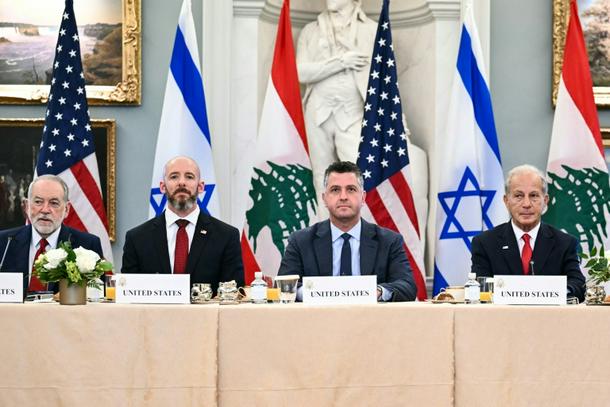
Direct talks between Lebanon and Israel were taking place in Washington
With Bahrain also complaining of overnight drone attacks from Iran, the United Arab Emirates called for a “cohesive Gulf stance” among neighbours in opposition to Tehran.
The Revolutionary Guards did not claim the attack on the civilian airport, but accused Kuwait and Bahrain of enabling US attacks and announced targeting a different location, “the Ali Al Salem Air Base in Kuwait, which hosts helicopters”.
Iran’s chief representative in negotiations with the US, Mohammad Bagher Ghalibaf, warned that any “aggression will be met with a decisive, regrettable, and proportionate response”.
The threat came a day before Iran was due to mark the anniversary of the death of former supreme leader Ruhollah Khomeini, founder of the Islamic republic, three months after his successor Ali Khamenei was killed in US-Israeli strikes.
A text statement from Khamenei’s son and successor Mojtaba is expected.
- Lebanon talks -
Earlier, the US military said it had “successfully defeated” a series of Iranian missile and drone attacks on Kuwait and Bahrain, and confirmed it had conducted strikes on Iran’s Qeshm Island.
Bahrain authorities said they had intercepted three Iranian missiles and a number of drones.
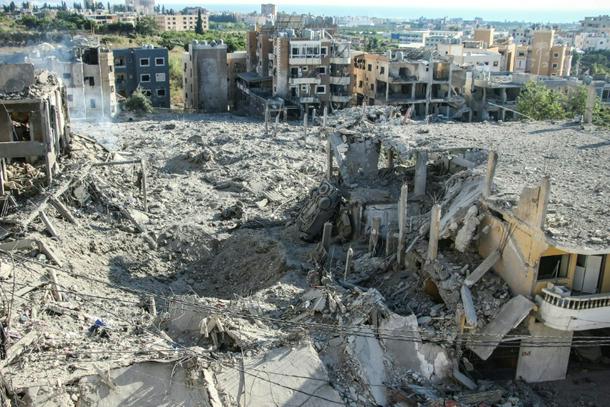
A photograph shows the aftermath of Israeli airstrikes in the Burj al-Chamali area near the southern Lebanese city of Tyre
The escalation came after US, Israeli and Lebanese officials met in Washington for direct talks on ending the parallel conflict between Israel and the Iran-backed group Hezbollah that began on March 2.
The Lebanese embassy in Washington said a US proposal to stop attacks would at first only cover Israeli strikes on Beirut and Hezbollah attacks on Israeli territory.
Neither side has publicly accepted the deal, and senior Hezbollah official Mahmud Qomati told AFP in a written statement that the group “will not accept a partial ceasefire”.
- New strikes -
US Secretary of State Marco Rubio said Washington wanted the talks to remain independent of those with Iran, but Tehran has repeatedly linked the two conflicts.
Israeli troops are staging their deepest ground offensive into Lebanon in two decades.
Lebanon said Israeli strikes on Wednesday killed at least nine people in the country’s south, including two paramedics, while another raid hit a car near Beirut.
Hezbollah claimed a rocket attack on Wednesday that targeted troops in northern Israel, saying it was responding to Israeli ceasefire violations.
A truce to halt the fighting in Lebanon was meant to take hold on April 17, but has never been observed.
Israeli officials have warned of strikes on Beirut’s southern suburbs if Hezbollah targets northern Israeli communities, a stance they say has backing from Washington.
Netanyahu said Wednesday that Trump shared his goal of disarming Hezbollah to “save Lebanon”.