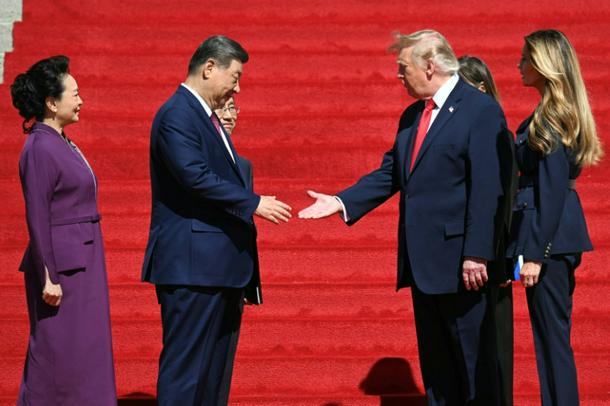
The US and China agreed to communicate on AI incidents after a Washington summit short on breakthroughs
Washington (United States) (AFP) - China and the United States agreed to set up a “communication channel” for artificial intelligence incidents, both sides said, after a Washington summit short on breakthroughs.
Donald Trump and Xi Jinping discussed matters ranging from AI and trade to the stalled war in Iran, and confirmed that they would meet for a third and fourth time this year at international summits in China and the United States.
Xi’s visit to Washington was marked more by pomp than substance, but the White House said on Friday the nations agreed to establish a “bilateral communication channel” for AI incidents.
Chinese state media confirmed the AI hotline was agreed in a report about the summit’s outcomes on Saturday.
While billionaire Trump has repeatedly dismissed fears that AI could pose a threat to humanity, Xi took a more measured tone, noting the technology must develop under human control.
The White House also reported some deals from the visit, including China agreeing to import at least 10 million metric tons of coal from the US in 2027 and 2028.
Additionally, the two countries agreed more favorable tariff treatment for $30 billion of “non-sensitive goods” in each direction and two Chinese pandas were to arrive at a US zoo.
Despite the focus on pomp and ceremony during the visit, the message from the US and Chinese sides was that the summit had nevertheless helped smooth tensions between the rival superpowers over a host of issues.
Trump said the meeting was “one of Friendship, Strength, and Success, for both China and the U.S.A.”
“We’ve made great strides, very positive for both countries,” Trump told reporters as he had tea with Xi at the White House on Friday before the archives trip.
- ‘Strategic stability’ -
Trump rolled out the red carpet throughout the visit, treating Xi to a state banquet full of US tech titans, plus military parades, a flyover and even a tour of his new White House helipad and ballroom.
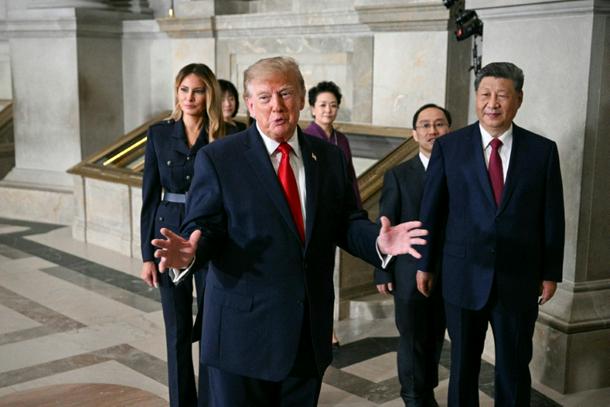
US President Donald Trump confirmed he had spoken with Xi about Iran
For his part, Xi said his Washington trip had added “new substance” to his summit with Trump in Beijing in May.
The Chinese leader added that they had agreed to “strategic stability on the basis of respect, fairness, and reciprocity.”
The announcement that the two leaders would continue their dialogue was perhaps the biggest deliverable for both sides.
Both leaders confirmed they would meet again at the APEC summit in Shenzen, China, in November and the G20 forum at Trump’s Doral resort in Miami in December.
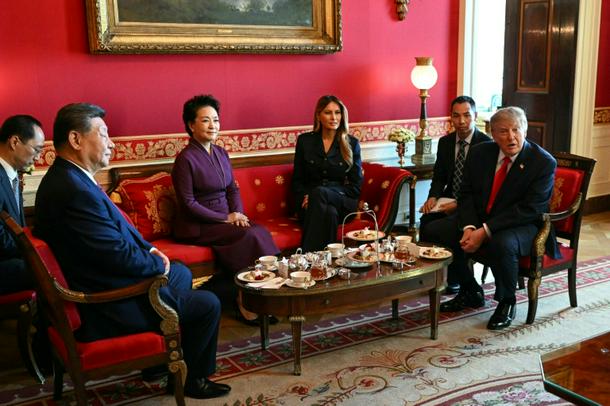
US President Donald Trump and First Lady Melania Trump hosted the Chinese presidential couple for tea at the White House
While visiting the National Archives in Washington, the leaders inspected the Declaration of Independence, which marks its 250th anniversary this year and which set out the path for American independence from the “tyrant” British king.
Beneath the rotunda, Trump also showed Xi the US constitution, the document that set out the principles of the country’s democratic government two and a half centuries ago.
“We’re just comparing how this goes 250 years, theirs goes 6,000 years,” Trump told reporters, referring to China’s ancient roots, as he stood alongside Xi, chairman of the Chinese Communist Party, which has ruled China since 1949.
- Iran talks -
Trump confirmed during the archive visit that the two leaders had discussed the US-Israeli war in Iran, which is approaching its seven-month mark.
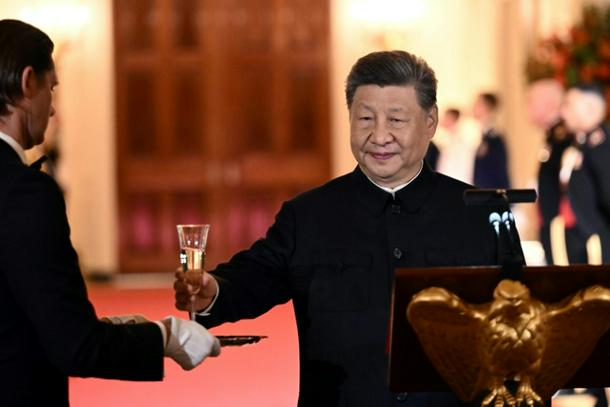
China's President Xi Jinping takes a glass to propose a toast during the State Dinner
The Republican has faced pressure from Democrats and his own party to confront Xi over reports that Beijing has supplied Tehran with intelligence for attacks on US troops.
“We did, we did,” Trump said at the National Archives when asked if they had talked about Iran.
Asked if he thought there would be progress on reopening the Strait of Hormuz, which is crucial for the flow of oil, Trump replied: “I think we’re going to do great.”
Trump’s showcasing of US democracy at the National Archives comes a week after he banned three major US media outlets from the White House. They were readmitted on Thursday on the orders of a US judge.
The First Amendment of the US Constitution protects the freedom of the press.
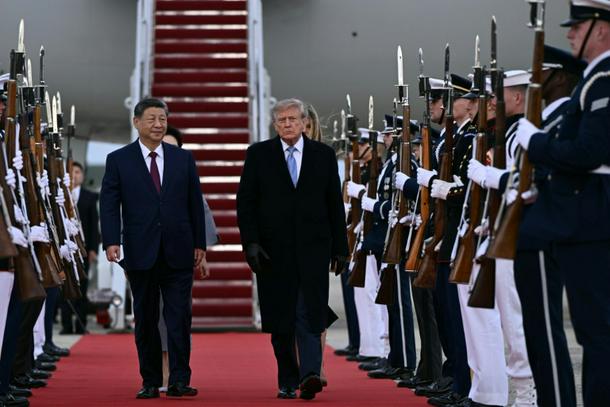
US President Donald Trump gave Chinese President Xi Jinping a rare personal airport welcome
Rights groups criticize China for its lack of press freedoms and the right of free expression.
Trump also publicly mocked his democratically elected predecessor Joe Biden as he gave Xi a tour of the White House on Thursday, showing him a picture of an “autopen” that he has mounted in a gallery of US presidents instead of Biden’s portrait.